Blended Dementia Disappears, Judgment Signals...It's particularly bright in certain areas
Dec 05, 2025


|

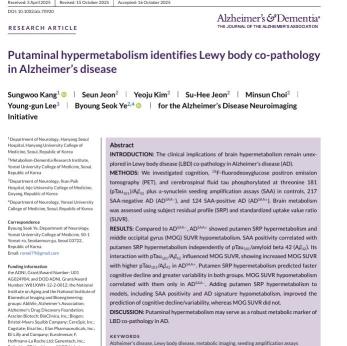
A joint research team led by Professor Ye Byung-seok of the Department of Neurology at Severance Hospital and Professor Jeon Se-woon of Yonsei University Medical School's Metabolic-Dementia Research Institute announced on the 5th that if the brain imaging test shows that 'putamen' deep inside the brain consumes more energy than other areas, Louis body pathology is more likely to be with Alzheimer's disease.
The findings were published in the latest issue of the international journal 'Alzheimer's & Dementia (IF 11.1)'.
Alzheimer's disease is a disease in which the brain part responsible for memory is getting weaker, and Louie's somatic disease is a disease in which there is a problem with brain signal control, resulting in hallucinations or Parkinson's symptoms that are not actually present. Although the causes of the two diseases are different, in reality, they often suffer together, making it easy to misdiagnose them as a single disease, making it difficult to distinguish and diagnose each disease.
In the meantime, FDG-PET has been known to have a characteristic of being observed darkly due to reduced energy use in the occipital lobe when suffering from Louie's somatic disease, but there was a limit to the distinction because it is a change that also occurs in Alzheimer's disease.
To solve this problem, the research team compared and analyzed energy use patterns throughout the brain. The study was conducted by analyzing 503 large-scale dementia data in the United States. As a result, the phenomenon of 'hypermetabolism' was repeated in which the Zogabin nucleus, which is responsible for motor control, was observed brightly in the deep part of the brain in the case of Louie's somatic disease. This phenomenon is present in the presence of Louie's somatic disease regardless of the patient's age or the degree of progression of Alzheimer's disease.
In addition, the brighter the crude nucleus appeared, the faster the cognitive function decreased and the condition change tended to increase. This means that the brightness of Joe's nucleus can be a clue to how fast the disease will progress in the future.
Professor Ye Byung-seok explained, "It is very important to detect mixed dementia early because it progresses quickly, and this result shows that the clue can be found only by imaging.".
Professor Jeon Je-woon added, `These changes were not seen well in the existing way, and it will help to establish customized treatment strategies for each patient in the future.'
|

This article was translated by Naver AI translator.