Bumin Hospital presents artificial joint surgery for a transverse incision robot...Reduce scarring and pain and improve initial recovery speed


Kung Yoon-bae, director of the Robot Surgery Center at Seoul Bumin Hospital, fundamentally reinterpreted the incision method of knee artificial joint surgery and is leading the 'transverse incision semi-substituted robotic surgery' that cuts along skin wrinkles.
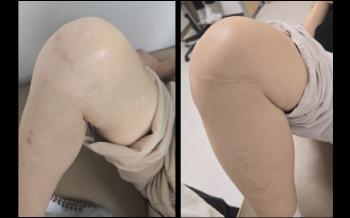
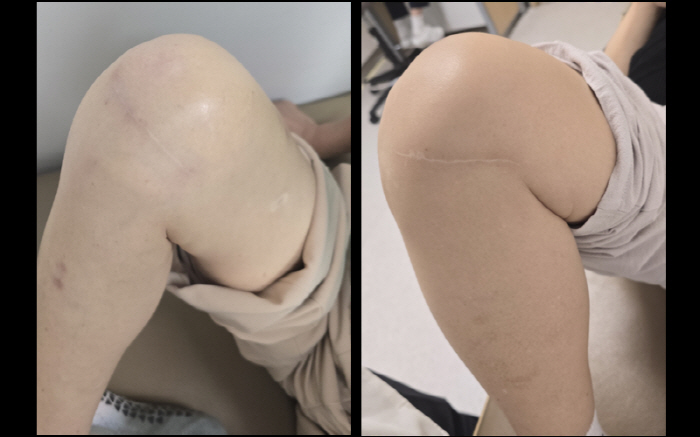
Longitudinal incision has long been used as the standard for knee artificial joint surgery, but it has been pointed out as a limitation in that the scar is noticeable and sensory abnormalities or pull pain can occur because it is in the opposite direction to skin tension.
In order to solve this problem, center director Gung Yoon-bae pays attention to the transverse incision method, which is cut along the Langer's line of the skin, and applies a new surgical method that increases cosmetic and functional satisfaction at the same time by combining it with MAKO robotic surgery.
In knee joint surgery, transverse incision has been confirmed in several academic reports in Japan, such as ▲ aesthetic superiority (no significant scarring) ▲ decreased incidence of sensory abnormalities ▲ decreased pain during knee flexion ▲ improved initial recovery speed after surgery.
On the other hand, there was a disadvantage that the visual field was narrow, but robotic artificial joint surgery is based on precise 3D planning and real-time joint position analysis, so even if the incision range is small, the accuracy can be maintained, making it possible to combine with transverse incision.
Through this, even if the incision is small, implant placement or joint spacing balance are accurately adjusted, further strengthening the advantages of artificial joint semi-substitution. Artificial joint semi-substitution is particularly effective for patients with early degenerative arthritis or single compartment arthritis, and it is faster to recover and allows natural joint use compared to pre-substitution.
International journals have also confirmed that robotic knee replacement surgery has fewer complications and reoperation rates than general surgery, and studies have reported that the more experienced surgeons perform, the lower the reoperation rate, supporting the stability of the reoperation.
"The purpose of the surgery is not just to replace the damaged area, but to help patients return to their daily lives more comfortably," said Gung Yoon-bae, head of the Seoul Bumin Hospital Center"Knees semi-substituted surgery, which combines skin wrinkle-based transverse incisions and precision robotic technology, will serve as a new knee surgery that will enable the best recovery with minimal scarring."
Longitudinal incision has long been used as the standard for knee artificial joint surgery, but it has been pointed out as a limitation in that the scar is noticeable and sensory abnormalities or pull pain can occur because it is in the opposite direction to skin tension.
In order to solve this problem, center director Gung Yoon-bae pays attention to the transverse incision method, which is cut along the Langer's line of the skin, and applies a new surgical method that increases cosmetic and functional satisfaction at the same time by combining it with MAKO robotic surgery.
In knee joint surgery, transverse incision has been confirmed in several academic reports in Japan, such as ▲ aesthetic superiority (no significant scarring) ▲ decreased incidence of sensory abnormalities ▲ decreased pain during knee flexion ▲ improved initial recovery speed after surgery.
On the other hand, there was a disadvantage that the visual field was narrow, but robotic artificial joint surgery is based on precise 3D planning and real-time joint position analysis, so even if the incision range is small, the accuracy can be maintained, making it possible to combine with transverse incision.
Through this, even if the incision is small, implant placement or joint spacing balance are accurately adjusted, further strengthening the advantages of artificial joint semi-substitution. Artificial joint semi-substitution is particularly effective for patients with early degenerative arthritis or single compartment arthritis, and it is faster to recover and allows natural joint use compared to pre-substitution.
International journals have also confirmed that robotic knee replacement surgery has fewer complications and reoperation rates than general surgery, and studies have reported that the more experienced surgeons perform, the lower the reoperation rate, supporting the stability of the reoperation.
"The purpose of the surgery is not just to replace the damaged area, but to help patients return to their daily lives more comfortably," said Gung Yoon-bae, head of the Seoul Bumin Hospital Center"Knees semi-substituted surgery, which combines skin wrinkle-based transverse incisions and precision robotic technology, will serve as a new knee surgery that will enable the best recovery with minimal scarring."
|
This article was translated by Naver AI translator.