Development of AI Model to Support Determination of Hepatocellular Cancer Surgery...54% less risk of death


|
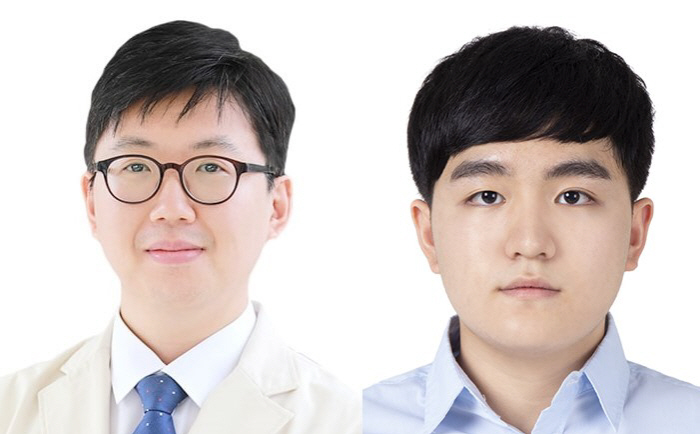
A research team led by Professor Han Ji-won of the Department of Gastroenterology at Seoul St. Mary's Hospital and Kim Hyun-wook of the Department of Medicine at Catholic Medical University wanted to implement an artificial intelligence discrimination tool that precisely determines which method will be more helpful to a specific patient among liver transplantation and hepatic resection, which are surgical treatments for hepatocellular carcinoma.
In general, liver transplantation has fewer recurrences than resection because it simultaneously solves the underlying liver function problem while removing the cancer itself, but it is difficult for all patients to receive transplants due to the lack of donors. Therefore, if the liver function is good, single tumor, and location is good, hepatic resection is considered first.
Until now, liver transplantation and hepatic resection have been judged based on the patient's emergency and donor conditions according to international guidelines. However, in the case of gray-zone patients located at the border, clinical decision-making is complicated, and the need for a tool to help accurately select patients who need transplantation has been raised.
In response, Professor Han Ji-won's team retrospectively analyzed a total of 4,529 patients (3915 induction cohorts and 614 external verification cohorts) using data from the Korea Central Cancer Registry and Seoul St. Mary's Hospital, and evaluated the suitability of each artificial intelligence model using a total of 30 variables (demographic factors, clinical characteristics, tumor-related variables, etc.). The evaluation method was conducted in such a way that each artificial intelligence model simulates a three-year survival rate after the patient undergoes liver transplantation or hepatic resection, based on various variables of a specific patient.
As a result of evaluating the artificial intelligence model developed by the research team with the performance evaluation index, Area Under the Receiver Operating Characteristic Curve (AUROC), the accuracy of the Support Vector Machine (SVM) model finding the optimal boundary to classify data in the case of liver transplantation was 82%, and the accuracy of the CatBoost model combining multiple decision trees was 79%.
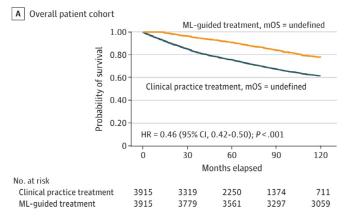
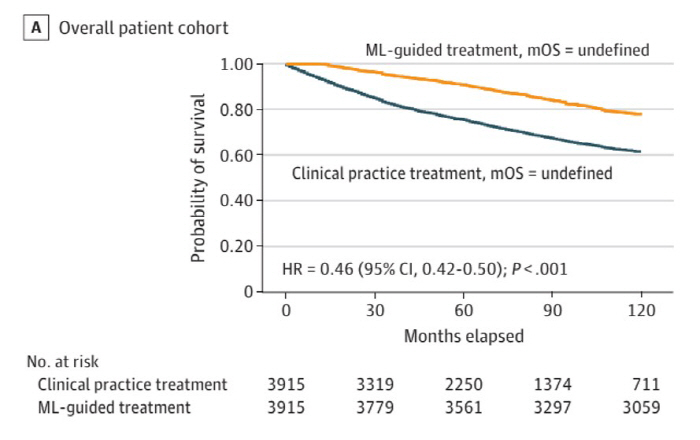
Simulation analysis showed that compared to conventional clinical decisions, treatment according to the recommendation of the model reduced the risk of death by 54%, and the statistical significance of the results was also very high (p<0.001).
The newly developed AI decision-making support model shows the possibility of presenting objective and quantified treatment directions to patients on the borderline, which are difficult to clearly judge with existing guidelines in the future. Although prospective verification is needed in the future, it can be a starting point for improving survival rates by comprehensively analyzing various variables and evaluating patient-specific risk.
In addition, the research model reclassified 74.7% of existing liver transplant patients with hepatic resection, and it was confirmed that liver transplantation was recommended only to 19.4% of hepatic resection patients. This suggested the possibility of allocating resources to essential patients by reducing unnecessary use of donor organs due to the nature of transplant diseases that are directly related to limited resource problems.
This study is meaningful in that it suggests the possibility of catching 'two rabbits' that improve the prognosis of individual patients and secure efficiency at the social level. In addition, it is evaluated that the achievement is significant in terms of 'training future medical scientists' as it was derived by a medical student under the guidance of a doctor scientist professor familiar with liver cancer treatment.
Professor Han Ji-won predicted that `The newly developed AI model for customized treatment for liver cancer patients will be a useful tool to provide an optimal treatment plan by providing individual survival estimates for each patient according to the prediction of liver transplantation and liver transplantation.'
The medical student was able to conduct such high-level research because it combines mentoring and student's outstanding research capabilities. The apologist believes that medical expertise and scientific research capabilities should be equipped with both medical expertise and scientific research capabilities, and we will continue to do our best to cultivate next-generation medical staff that combine AI technology and clinical knowledge as well as patient treatment."Meanwhile, the government's support for the 'Global Medical Scientist Training Project', which aims to strengthen the competitiveness of medical research and industry, was published in the international journal 'JAMA Network Open (Impact factor 9.7)' published by the American Medical Association, after winning the Excellence Prize in the 'The Liver Week 2025' held in May.
|
This article was translated by Naver AI translator.