Investigating the relationship between depressive symptoms and blood protein changes in early Alzheimer's patients...expectation of customized treatment
Dec 05, 2025


|
Amyloid-beta and tau proteins, which are known to be closely related to Alzheimer's disease called senile dementia, have a positive function in maintaining and protecting nerve cells under normal conditions. However, when they aggregate according to degenerative changes, amyloid-beta and tau proteins accumulate inside and outside nerve cells, respectively, causing cognitive decline.
About 20-30% of these Alzheimer's disease patients are known to be accompanied by depression and emotional changes, and accordingly, studies have shown that amyloid-beta and tau proteins are also related to depression. However, as the interaction between the two proteins has not been clearly identified, the study is drawing attention from academia by suggesting the possibility of a new blood-based biomarker (biomarker) for the onset of depression in the early stages of Alzheimer's disease.
The research team analyzed oligomerized amyloid-beta and tau protein test images measured by blood-based multimer detection technology (MDS) in a total of 103 patients with mild cognitive impairment, Alzheimer's dementia, and normal control.
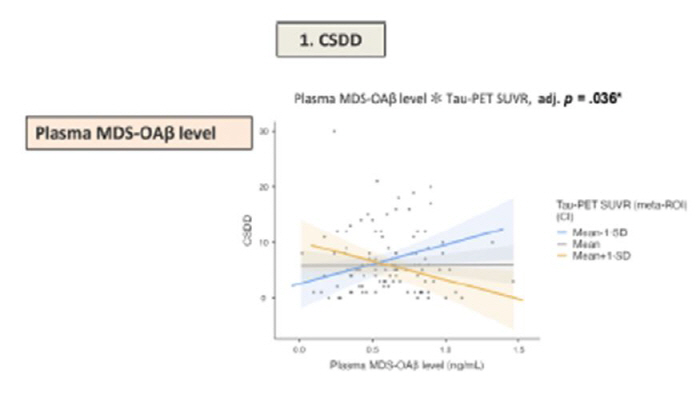
As a result, oligomerized amyloid-beta showed a positive association with depressive symptoms in a group with a low degree of tau protein pathology, but a negative association was confirmed in a group with a high degree of tau protein pathology.
This means that if there is not yet much tau protein deposition related to Alzheimer's disease among patients with mild cognitive impairment or early dementia, high amyloid-beta oligomer levels in the blood may be accompanied by depressive symptoms.
Recently, Korea is rapidly entering an aging society, and as of 2021, about 10.4% of the elderly aged 65 or older were reported to have been diagnosed with dementia. Dementia is largely divided into Alzheimer's disease and vascular dementia, of which Alzheimer's disease is the most common form, accounting for about 55-70% of all dementia. If the cause of some dementia is clearly identified, cognitive decline can be partially improved by treating the cause, and this reversible dementia is reported to be about 10-15% of all dementia.
However, the most common Alzheimer's disease is still difficult to treat fundamentally. The pathogenesis is not explained by a single factor, and it is understood that various factors such as amyloid-beta accumulation, pathological changes in tau protein, genetic predisposition, vascular health, and lifestyle are combined to cause neurodegeneration.
Major biomarkers for identifying Alzheimer's disease pathology include cerebrospinal fluid testing and amyloid and tau protein measurements via positron emission tomography (PET). Recently, blood-based biomarker research has been actively conducted, and attempts to measure Alzheimer's disease-related protein changes in the blood are expanding. The results of this study provide evidence to explore the possibility of use in early identification of risk groups for depressive symptoms in Alzheimer's disease dementia patients.
Professor Kang Dong-woo "It is possible that oligomerized amyloid-beta is associated with depressive symptoms in the early stages of Alzheimer's disease, i.e., in the pre-expanding phase of extensive tau protein accumulation", and "These proteins, which can be measured in the blood, can be considered as biomarkers that have potential to be utilized in the evaluation of early depression in Alzheimer's disease patients in the future and the preparation of personalized treatment strategies." he said.
The results of the study, which were carried out with the support of Seoul St. Mary's Hospital, the Korea Research Foundation Basic Research Project, the Ministry of Culture, Sports and Tourism, the Korea Creative Content Agency's Cultural Technology Research and Development Project, and the Catholic Medical Center Basic Medicine Promotion Project, were recently published in the international journal 『The Journal of Prevention of Alzheimer's Disease, IF 7.8, Top 5% in clinical neuroscience』.
|

This article was translated by Naver AI translator.