H+ Yangji Hospital Robot Gastric Sleeve Resection Rise Techniques Change the Stage of High Obesity Surgery
Dec 01, 2025


H Plus Yangji Hospital's Robot Surgery Center is said to have taken the safety of highly obese surgery to the next level by introducing a new gastrectomy using Da Vinci robot, 'RISE (Rotic In-situ Sleep Examination/Rise) technique'.
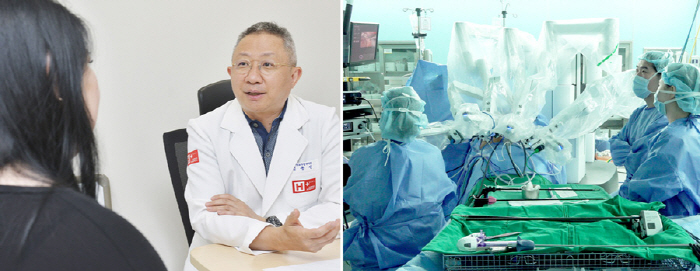
Robot-based 'Rise Technique' established by Kim Yong-jin, director of the Robot Surgery Center, is a method that completely reverses the order of existing gastrectomy. Previously, the blood vessels were first dissected and then resected along the stomach, making it difficult to secure visibility for highly obese patients, and excessive traction in the stomach led to a high risk of spleen damage or bleeding. On the other hand, this surgical method significantly reduces risk factors by using the Da Vinci robot to remove the stomach first and process blood vessels, and sets a new standard for gastrectomy.
A retrospective comparison of highly obese patients who recently underwent robotic surgery using large-scale obesity surgery data in the United States (a research design method that analyzes using historical data) showed that complications, readmissions, and mortality rates were all "zero (0%)" in this hospital.
Center Director Kim Yong-jin explained, `The robot arm moves freely like a human wrist to safely access the deep space behind the stomach, and even if the adhesion is severe, it has excellent visibility and can be removed by freely turning the stomach, so there is no risk of shaking or twisting the ablation line.'
In particular, staplers and energy instruments dedicated to da Vinci robots are key equipment that greatly increase surgical safety. The stapler accurately enters the desired angle and straightens the stomach, and the energy device stops and sutures at the same time as soon as it catches the blood vessel, significantly reducing the possibility of complications such as leakage and stenosis.
Thanks to these advantages, more and more patients are visiting Kim Yong-jin, the head of the center, who were rejected by other hospitals saying `the degree of obesity is too high.' In addition to ultra-high obesity patients with a BMI of 50 or higher, patients with re-surgery with severe adhesion due to past gastric band surgery and previous gastric bypass surgery can now operate safely with a robot-based 'rise technique'.
Director Kim, who is set to achieve 5,000 cases of obesity metabolic surgery next month, emphasized that `Robot surgery goes beyond these limits and provides the same level of precision and safety for all patients if laparoscopic surgery had physical limitations in vision and instrument manipulation in patients with high obesity and severe adhesion.'
In addition, he added, `Obesity is not a disease that ends with medication not working, but rather it requires full-scale treatment from then on, and robotic surgery is an effective solution, so you don't have to be afraid," he added.
Robot-based 'Rise Technique' established by Kim Yong-jin, director of the Robot Surgery Center, is a method that completely reverses the order of existing gastrectomy. Previously, the blood vessels were first dissected and then resected along the stomach, making it difficult to secure visibility for highly obese patients, and excessive traction in the stomach led to a high risk of spleen damage or bleeding. On the other hand, this surgical method significantly reduces risk factors by using the Da Vinci robot to remove the stomach first and process blood vessels, and sets a new standard for gastrectomy.
A retrospective comparison of highly obese patients who recently underwent robotic surgery using large-scale obesity surgery data in the United States (a research design method that analyzes using historical data) showed that complications, readmissions, and mortality rates were all "zero (0%)" in this hospital.
Center Director Kim Yong-jin explained, `The robot arm moves freely like a human wrist to safely access the deep space behind the stomach, and even if the adhesion is severe, it has excellent visibility and can be removed by freely turning the stomach, so there is no risk of shaking or twisting the ablation line.'
In particular, staplers and energy instruments dedicated to da Vinci robots are key equipment that greatly increase surgical safety. The stapler accurately enters the desired angle and straightens the stomach, and the energy device stops and sutures at the same time as soon as it catches the blood vessel, significantly reducing the possibility of complications such as leakage and stenosis.
Thanks to these advantages, more and more patients are visiting Kim Yong-jin, the head of the center, who were rejected by other hospitals saying `the degree of obesity is too high.' In addition to ultra-high obesity patients with a BMI of 50 or higher, patients with re-surgery with severe adhesion due to past gastric band surgery and previous gastric bypass surgery can now operate safely with a robot-based 'rise technique'.
Director Kim, who is set to achieve 5,000 cases of obesity metabolic surgery next month, emphasized that `Robot surgery goes beyond these limits and provides the same level of precision and safety for all patients if laparoscopic surgery had physical limitations in vision and instrument manipulation in patients with high obesity and severe adhesion.'
In addition, he added, `Obesity is not a disease that ends with medication not working, but rather it requires full-scale treatment from then on, and robotic surgery is an effective solution, so you don't have to be afraid," he added.
|
This article was translated by Naver AI translator.