Himchan Hospital presents a paper on the accuracy of alignment of the sagittal plane for robot artificial joint surgery...Difference between doctor's eye vs robot sensor
Dec 04, 2025


|
Unlike previous studies that mainly focused on lower limb alignment at the front, this paper is considered significant in that it analyzed the accuracy of sagittal plane, or lateral alignment, which has an important effect on the stability and function of knee joints.
◇ Physician's Visual Evaluation vs Robot Sensor…I can see the difference in the alignment of the sagittal plane
Knee arthroplasty is a treatment for pain relief and functional improvement in patients with end-stage knee osteoarthritis, and the long-term success of surgery depends on the alignment of the lower extremities that normally restore the patient's leg axis with the correct insertion of the artificial joint. In particular, sagittal alignment, which is alignment on the side, is a major factor in determining the risk of hypertension or flexion contraction of the knee after surgery.
Over-extension of the knee can strain or damage the surrounding ligaments or muscles, and flexural construction can cause long-term sequelae such as knee instability, walking disorders, and increased risk of falls.
The joint research team at Himchan Hospital's Arthrogynecology Research Institute and Harvard University Hospital's orthopedic surgery compared and analyzed the accuracy of sagittal plane alignment determined by doctors during knee artificial joint replacement surgery and when using robot sensors.
From October 2023 to May 2024, 60 total knee arthroplasty cases were performed using the Mako Smart Robotics system, and the angle of alignment of the sagittal plane according to the thickness of 9, 10, and 11 mm of the artificial joint inserts was divided into visual estimates of orthopedic surgeons and robot sensor measurements. Accuracy of both figures was evaluated by comparing them with radiographic imaging measurements taken immediately after surgery.
As a result, the doctor's visual evaluation confirmed that errors may occur depending on changes in the thickness of the artificial joint implant. When the thickness of the insert was as thin as 9mm, it tended to evaluate that the over-extension of the knee, which seemed to be over-extended, was more severe than it actually was. In addition, when using thick inserts of 11 mm, there were cases in which a slightly curved state was judged as the normal range due to increased joint spacing and increased soft tissue tension.
◇ The more overweight and obese you are, the greater the margin of error in visual evaluation
In particular, in overweight and obese patients with a BMI of 25 kg/㎡ or more, it was confirmed that the subcutaneous fat layer and thick soft tissue limited the field of vision, further increasing the range of error in the doctor's visual evaluation. This is the result of poor accuracy of alignment judgment due to difficulty in grasping the anatomical structure.
On the other hand, robot sensors provided consistent and objective sagittal alignment measurements regardless of changes in artificial joint implant thickness or soft tissue constraints. There was no statistically significant difference from the actual radiographic image measurements. In other words, the robot system showed higher reproducibility and accuracy than the visual judgment of the density in alignment of the sagittal plane.
The study scientifically identified the possibility of sagittal alignment errors that can occur if the knee artificial joint replacement only relies on visual evaluation of the intensity, and suggested clinical significance that the robotic surgery system accurately determines sagittal alignment even in changing soft tissue conditions and implant conditions. In addition, unlike previous studies that have mainly focused on the accuracy of front alignment, it is significant in that it objectively confirmed the precision of robotic surgery in lateral alignment.
The first author, Lee Dong-nyeong, head of the orthopedic clinic at Himchan Hospital, said "The visual alignment has a decisive effect on the movement axis and load transmission of the knee joint, and even minute errors can affect the long-term prognosis"We were able to confirm that robotic surgery systems can provide reliably consistent results in special situations where severe deformations are accompanied or difficult to grasp anatomical structures and visual assessment, such as highly obese patients."
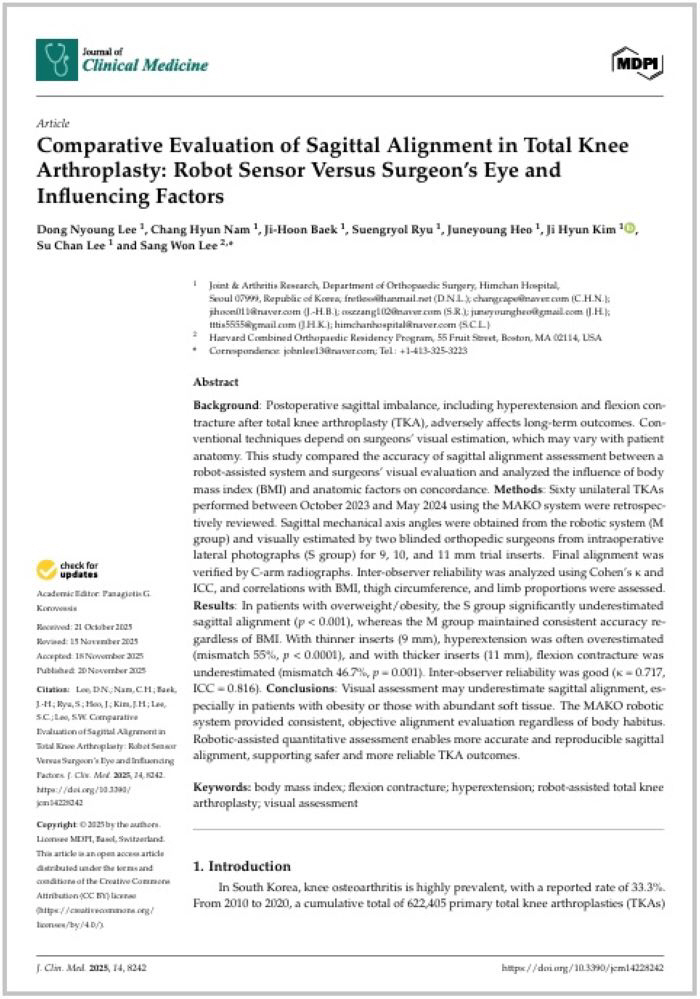
The findings were published in the November 2025 issue of the SCIE international journal Journal of Clinical Medicine under the title 'Comprehensive Evaluation of Sagittal Alignment in Total Knee Arthroplasty: Robot Sensor Versus Surgeon's Eye and Influencing Factors'.
|

This article was translated by Naver AI translator.