Developing AI to record check-out instead of emergency room doctors...Expect to reduce administrative work and increase treatment hours
Dec 04, 2025


|
This is expected to reduce the administrative burden on emergency room doctors and increase the amount of time available to patients.
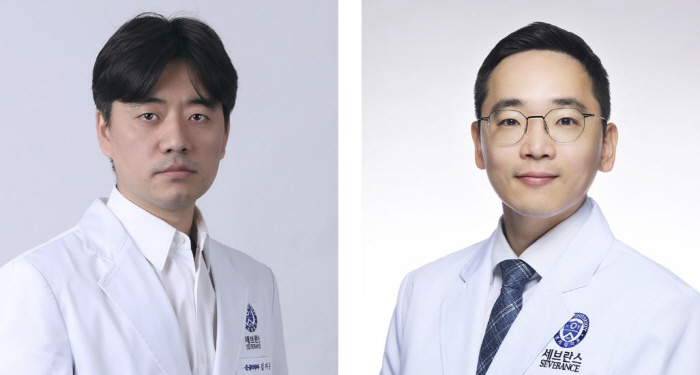
Professor Kim Ji-hoon of Yonsei University's School of Emergency Medicine, Professor Yoo Seung-chan of Medical Life System Information Studies, and Song Ji-woo, a fourth-year medical student, announced on the 4th that they have developed an AI model 'Y-Knot' that includes the safety of protecting patient information based on a large-scale language model.
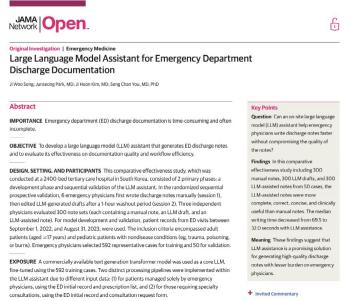
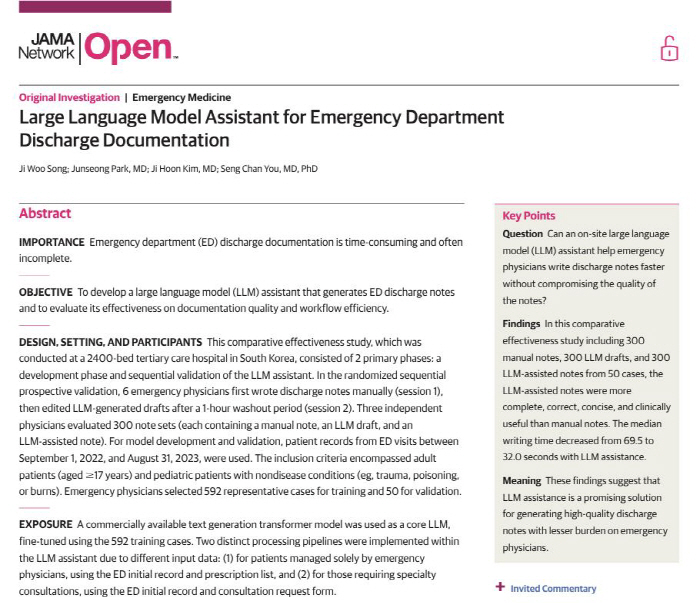
The paper, which comprehensively contains the efficacy and accuracy of the AI model developed by the research team, as well as the satisfaction of actual doctors, was published in the latest issue of the international academic journal `JAMA Network Open (IF 10.5).'
Emergency room doctors who conduct rapid examinations and treatments from time to time must prepare an emergency patient medical record, also called the 'exit record sheet', in accordance with the medical law. Records of the entire process of treating the patient, such as the reason for visiting, test results, treatment details, progress, whether to transfer, and the reason for the decision to leave the hospital, should be included.
Although it is a necessary process to manage patient safety and ensure continuity of treatment, doctors who treat a rapid influx of emergency patients have no choice but to increase their workload.
To solve these difficulties, a research team at Yonsei University has developed an AI model that automatically creates emergency patient medical records based on a large-scale language model.
When the AI model drafts the record book, the doctor only needs to confirm the level of review.
Large Language Model (LLM) is an artificial intelligence learning technology that learns vast amounts of text and creates sentences.
Previously, there was an AI model using a large language model, but based on the use of a network capable of communicating with the outside of the emergency room, there was a risk of leakage of sensitive information, including the patient's health condition, for use in hospitals.
To solve this problem, the research team designed AI models based on 'on-site large-scale language models' and 'light transformer models (Llama3-8B)'. The on-site large-scale language model operates directly on the internal server of the hospital without external network connections, and the lightweight Transformer model reduces its size while maintaining the performance of the AI model, allowing it to run on the internal server without problems.
Thanks to this, it can be used inside the emergency room's internal web without being connected to the outside, preventing problems caused by loss of personal information such as leakage of patient sensitive information.
As a result of using the AI model developed by the research team for six emergency medical doctors at a high-level general hospital with 2,400 beds in Korea, it was confirmed that the time to write emergency patient medical records was reduced by more than 50%. It took an average of 69.5 seconds for emergency medical doctors to write their own records, but when the AI model was used, the writing time was reduced to 32.0 seconds.
In addition, the record paper prepared with the help of the AI model was better than the doctor's handwritten record paper in terms of quality. The research team had three emergency medical doctors randomly view records made using AI models and handwritten records, and evaluated records in four aspects: completeness, accuracy, simplicity, and clinical usefulness.
Professor Kim Ji-hoon of the emergency medicine class said, "The creation of emergency patient medical records using AI models was much better than the existing handwriting in terms of speed and quality. The use of internal networks will allow us to spend more time treating patients with safety information."
"It can be used not only in the emergency medicine department but also in other departments," said Yoo Seung-chan, a professor of bio-system information studies at the Medical Center. "However, as we continue to carry out supplementary procedures, a final review by a specialist is essential."
|
This article was translated by Naver AI translator.