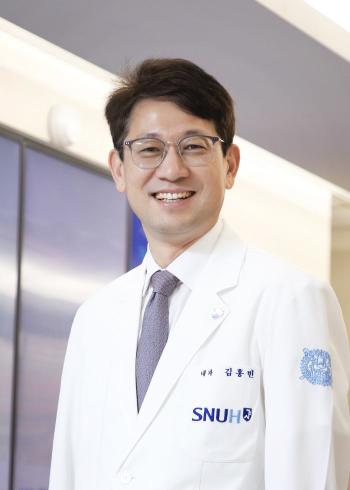
Genetic research into space...Professor Park Chan-heum's team at Hallym University Chuncheon Sacred Heart Hospital won the grand prize in the Space Hackathon
Dec 03, 2025


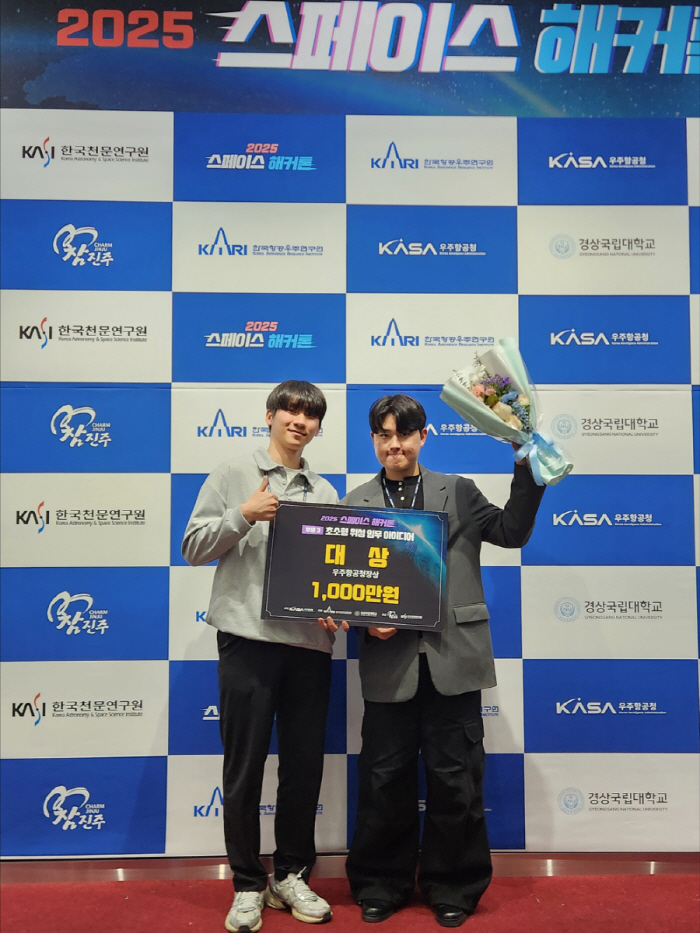
Researchers Kim Ki-hyun, Lee Chul-hee, and Son Yoo-sang, an integrated master's and doctoral students in the team led by Professor Park Chan-heum (Director of the Nano-Bio Regenerative Medicine Research Institute at Hallym University), Chuncheon Sacred Heart Hospital, won the grand prize in the 'Space Hackathon Contest' ultra-small satellite mission idea category hosted by the Korea Aerospace Administration on November 27.
The Space Hackathon is a competition held by the National Aeronautics and Space Administration to expand the use of satellite information, promote satellite information-AI convergence, and discover the next generation of aerospace talents. About 284 people from 114 teams, including college students and start-up workers, participated in this year's competition, of which 75 people from 30 teams advanced to the finals and competed fiercely.
The competition will be divided into three categories: ▲ Idea for utilizing satellite information big data ▲ Business model for using satellite ▲ Idea for ultra-small satellite missions, and participants will select topics themselves.
Professor Park Chan-heum's team presented a research titled 'Real-time Orbit In-Situ PCR System' in the field of micro-gravity mission ideas in space. This study is a research on the development of a 'orbital in-situ PCR system' that automatically performs the entire process from gene extraction to PCR amplification, fluorescence detection, and ground transmission in a very small autonomous satellite (CubeSat) to enable real-time gene analysis in space sites.
The system is designed to allow automatic preparation and analysis of Candida samples in space. The process of melting and mixing the sample is also automatically performed, and a small structure was used to make the sample move without a separate pump. In addition, there is a device that precisely controls the temperature inside the satellite, so PCR (gene amplification) experiments can be performed stably. The data analyzed in this way is transmitted to the ground in real time.
Most of the existing space biotechnology studies were conducted by collecting samples from the ISS (the International Space Station, hereinafter referred to as the ISS) and bringing them back to Earth for analysis. However, during the return process, the genetic signal was deformed due to radiation, vibration, and temperature changes, and it took several weeks to analyze, making it difficult to respond in real time. Therefore, a technology that can be analyzed immediately at the space site was needed.
The purpose of this study is to implement the world's first space field analysis platform that can immediately detect and monitor genetic changes and infection risks of life in space microgravity and radiation environments beyond the limitations of existing methods.
Professor Park Chan-heum said, "Candida bacteria, which have been selected as a research target, are microorganisms that have been reported to be highly pathogenic in space environments, and we plan to continue scientific verification compared to the results of future ISS experiments. The technology developed this time can conduct highly pathogenic bacterial research that cannot be performed on the ISS and can be extended to an ultra-small autonomous satellite-based platform that can be conducted at low cost and repeated experiments, so we expect it to make meaningful contributions to space bio research and the creation of a private biotechnology ecosystem in the future."
Meanwhile, Professor Park Chan-heum's team will receive 10 million won in prize money and support for overseas space agency exploration programs.
The Space Hackathon is a competition held by the National Aeronautics and Space Administration to expand the use of satellite information, promote satellite information-AI convergence, and discover the next generation of aerospace talents. About 284 people from 114 teams, including college students and start-up workers, participated in this year's competition, of which 75 people from 30 teams advanced to the finals and competed fiercely.
The competition will be divided into three categories: ▲ Idea for utilizing satellite information big data ▲ Business model for using satellite ▲ Idea for ultra-small satellite missions, and participants will select topics themselves.
Professor Park Chan-heum's team presented a research titled 'Real-time Orbit In-Situ PCR System' in the field of micro-gravity mission ideas in space. This study is a research on the development of a 'orbital in-situ PCR system' that automatically performs the entire process from gene extraction to PCR amplification, fluorescence detection, and ground transmission in a very small autonomous satellite (CubeSat) to enable real-time gene analysis in space sites.
The system is designed to allow automatic preparation and analysis of Candida samples in space. The process of melting and mixing the sample is also automatically performed, and a small structure was used to make the sample move without a separate pump. In addition, there is a device that precisely controls the temperature inside the satellite, so PCR (gene amplification) experiments can be performed stably. The data analyzed in this way is transmitted to the ground in real time.
Most of the existing space biotechnology studies were conducted by collecting samples from the ISS (the International Space Station, hereinafter referred to as the ISS) and bringing them back to Earth for analysis. However, during the return process, the genetic signal was deformed due to radiation, vibration, and temperature changes, and it took several weeks to analyze, making it difficult to respond in real time. Therefore, a technology that can be analyzed immediately at the space site was needed.
The purpose of this study is to implement the world's first space field analysis platform that can immediately detect and monitor genetic changes and infection risks of life in space microgravity and radiation environments beyond the limitations of existing methods.
Professor Park Chan-heum said, "Candida bacteria, which have been selected as a research target, are microorganisms that have been reported to be highly pathogenic in space environments, and we plan to continue scientific verification compared to the results of future ISS experiments. The technology developed this time can conduct highly pathogenic bacterial research that cannot be performed on the ISS and can be extended to an ultra-small autonomous satellite-based platform that can be conducted at low cost and repeated experiments, so we expect it to make meaningful contributions to space bio research and the creation of a private biotechnology ecosystem in the future."
Meanwhile, Professor Park Chan-heum's team will receive 10 million won in prize money and support for overseas space agency exploration programs.
|
This article was translated by Naver AI translator.